
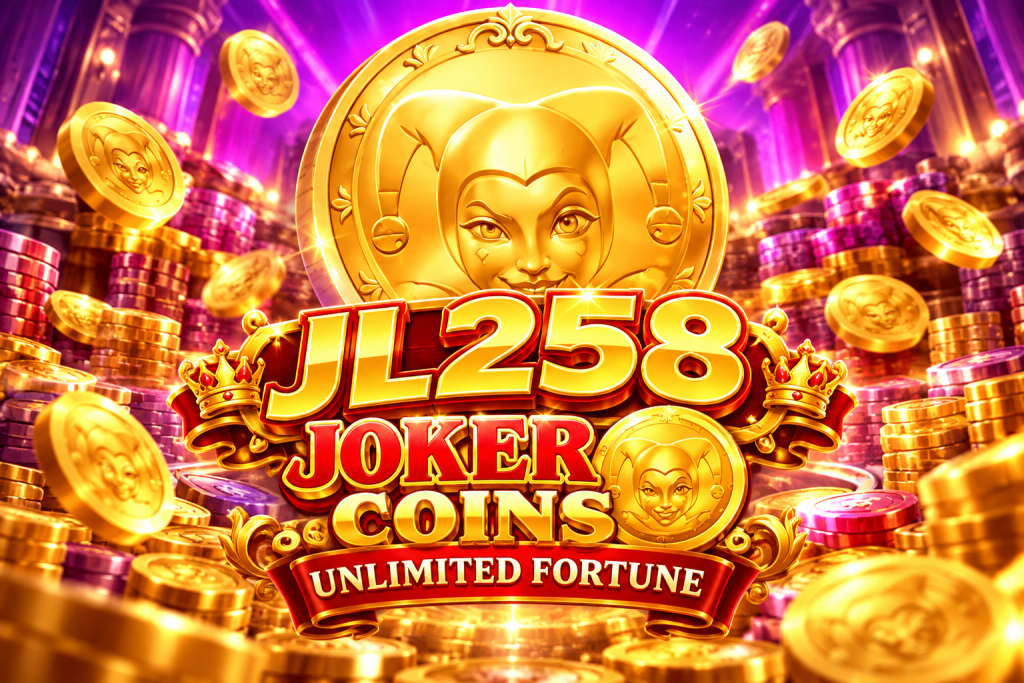
A golden joker coin sits at the center of a room filled with glittering tokens. Smaller coins float around it, while purple and gold lights illuminate the background. At first glance, the scene feels like a celebration of endless possibilities.
That is the impression created by Joker Coins: Unlimited Fortune.
Yet there is a practical question behind the artwork. When a game features dozens of coins, how can players tell which ones are decorative, which carry a value, and which may serve a special purpose?
The distinction matters because coins do not function the same way in every game. Some represent ordinary symbols, others display numerical values, and certain games use coin-related features with their own conditions.
For players browsing titles through JL258, understanding these differences is more useful than assuming that every gold coin on the screen has the same meaning.
This guide looks at the visual identity of Joker Coins, explains common coin-based mechanics, and shows what players should examine before drawing conclusions from the game’s title or animations.
The Joker Behind the Gold: Why Character Design Matters
The most recognizable element in the Joker Coins artwork is not the amount of gold. It is the face engraved on the central coin.
The character wears a traditional jester’s hat and has a mischievous expression. Unlike a king, knight, or mythological hero, a joker suggests unpredictability.
That association has a long history in playing cards and entertainment. A joker can represent something unusual, an exception to ordinary rules, or an unexpected change.
In game design, that makes the character visually useful.
A joker-themed symbol immediately tells players to pay attention, even before its function has been explained.
However, visual importance does not automatically establish a special mechanic.
A joker may be the game’s mascot, an ordinary symbol, or a symbol with a specific function. Its actual role depends on the rules of the title being played.
The golden joker coin in this illustration establishes the theme, but it does not prove that the game uses a particular Wild, substitution, or multiplier system.
Players should make that distinction before interpreting what they see.
One Coin Can Have Several Different Meanings
Imagine opening a coin-themed game and seeing three kinds of objects: a gold coin without a number, a coin marked with a value, and a larger coin surrounded by a bright outline.
They may look related, but they are not necessarily interchangeable.
A coin without a number might be a regular symbol or simply part of the background. A numbered coin could represent a value assigned under a particular feature. A glowing coin might indicate a special condition, although the glow alone is not enough to confirm that.
The important question is not how impressive a coin looks. It is how the game defines that coin.
Some titles distinguish symbols through numbers. Others use colors, borders, or small icons. Still others explain the differences only in the information panel.
For this reason, reading the symbol guide is often more informative than watching the opening animation.
The artwork may introduce the theme, but the rules explain what each object actually does.
Coin Value and Coin Multiplier Are Not the Same Thing
Two terms that can be easily confused are coin value and coin multiplier.
A coin value refers to an amount assigned to a coin under a game’s rules. A multiplier changes another value by a specified factor.
Consider a fictional example.
A game displays a coin with a value of 20 units. Another symbol displays a multiplier of 3×.
If the rules explicitly allow the multiplier to apply to that coin, the calculated amount could become 60 units.
But that calculation only applies if the game defines such an interaction.
In another title, the 3× symbol might affect an entirely different part of the game. It could apply to a qualifying combination, a feature total, or a specific event rather than an individual coin.
Likewise, a coin showing the number 20 does not automatically mean the player receives 20 units of currency. The number may be interpreted according to a denomination, feature rule, or another calculation.
The safest approach is to identify three things: what the number represents, when it is counted, and whether another symbol can modify it.
Without those details, a displayed number can easily be misunderstood.
Why a Large Coin Is Not Necessarily More Valuable
The central joker coin in the illustration is much larger than the surrounding coins.
That makes sense from a design perspective. The largest object draws attention and helps viewers recognize the theme.
But size in promotional artwork is not the same as value in a game.
A large coin may be a decorative centerpiece. A smaller symbol may carry a specific value, or vice versa.
Even within an actual game screen, symbol size may be influenced by animation rather than by its numerical significance.
For example, a coin might briefly enlarge when it appears. The enlargement could be a visual acknowledgment, not a change in value.
Players should therefore rely on labels, counters, and game instructions rather than the physical size of an animated object.
This is especially important in games that use bright gold effects, because visual emphasis can make ordinary events feel more significant than they are.
What Does “Unlimited Fortune” Really Mean?
The phrase Unlimited Fortune is prominent in the artwork, and it naturally creates curiosity.
Does it mean that a game has no limits? Does it refer to an ongoing feature? Or is it simply part of the title?
The wording alone cannot answer those questions.
In entertainment branding, phrases such as “Unlimited Fortune” often communicate abundance, excitement, or a sense of possibility.
They should not be interpreted as a guarantee of unlimited rewards, unrestricted play, or continuous favorable results.
Actual limits and conditions, where applicable, are determined by the game’s rules.
A game may specify maximum values, feature conditions, eligibility requirements, or other restrictions.
If a title includes a feature described as unlimited, players still need to read exactly what that description applies to.
It might concern a particular game mechanic rather than the entire experience.
The key is to separate promotional language from operational rules.
A memorable title creates an expectation about the theme. It does not replace the information required to understand how the game works.
A Practical Example: Reading a Coin-Based Feature
Suppose a fictional game displays four numbered coins during a special sequence.
The values shown are 5, 10, 15, and 20.
At first glance, a player might assume that the total is 50.
That would be correct only if the rules say all four values are counted together.
What if the game requires coins to appear in specific positions? What if only certain colors qualify? What if one coin is a modifier rather than a value?
Each of those conditions changes the interpretation.
Now imagine that the screen also shows a joker symbol.
A player familiar with card games might assume the joker can replace any missing coin.
But the joker could have a completely different role, or no special role at all.
The correct interpretation must come from the game instructions.
This example illustrates a broader principle: recognizing familiar symbols is helpful, but familiarity is not a substitute for understanding their actual functions.
The Difference Between a Coin Animation and a Recorded Value
The Joker Coins artwork uses floating gold coins to create a sense of movement.
In a real game, similar animations may appear when symbols enter the screen, a sequence begins, or a particular event is presented.
However, an animation is not always a record of a completed calculation.
A coin flying toward a counter might suggest that something has been collected. But the player should still check whether the counter changes.
Likewise, a group of coins falling across the screen may be purely decorative.
A useful way to read such events is to focus on the information that remains after the animation ends.
Does a numerical total change? Does an indicator update? Is a new symbol displayed? Does the game provide a message explaining what happened?
Those details are more reliable than the number of coins moving across the screen.
Visual effects can make an event easier to notice, but they do not independently define its meaning.
When Coin Features Use Different Rules Across Games
One reason coin-themed games can be confusing is that their symbols often look similar.
Gold coins, stars, crowns, and jokers appear in many titles.
Yet two games can use identical-looking objects in completely different ways.
In one title, coins may be regular symbols. In another, numbered coins may participate in a special feature. A third game might use coins as progress markers rather than directly calculated values.
This is why players should avoid transferring assumptions from one title to another.
Learning the rules of a previous game can provide useful familiarity with the interface, but it does not establish the rules of a new title.
Even games from the same provider can differ in their feature conditions.
The name, provider, and information panel should always be checked individually.
Finding Coin-Themed Titles through JL258 Login
Players interested in joker characters and coin-based themes can begin by accessing their accounts through JL258 Login using a verified platform address.
Once signed in, they can browse the available game categories and look for titles featuring coins, card-inspired characters, or other related imagery.
It is worth checking the complete title and game provider before opening a game.
A similar illustration does not necessarily indicate the same mechanics.
If the selected title includes a help or information section, players should review its symbol descriptions, calculation rules, and feature conditions.
That information can clarify whether a joker is a regular symbol, whether numbered coins have a specific purpose, and how any displayed values are interpreted.
The Joker Coins: Unlimited Fortune artwork does not, by itself, establish that a game with this exact title is available in the JL258 catalog. Availability should be confirmed on the platform.
Viewing Game Information with JL258 APP
Some players prefer accessing games on their phones, particularly when they want to browse titles without using a desktop computer.
Where an authorized mobile application is available, JL258 APP may provide an additional way to access supported content.
For a coin-themed game, screen clarity matters.
Small numbers printed on coins, feature descriptions, and calculation indicators should remain readable on a mobile display.
If a number is difficult to distinguish, players should look for an information panel or another supported way to inspect the rules rather than guessing.
Mobile layouts may also arrange menus differently from desktop versions.
That does not automatically mean the game mechanics have changed.
Before installing any application, users should verify the source, review requested permissions, and confirm compatibility with their device.
Android installation packages cannot be installed directly on iPhones or iPads. Users of those devices should rely on an authorized iOS option or a compatible browser version, where available.
Why Understanding the Rules Matters More Than the Artwork
Joker Coins is visually built around abundance.
Gold fills the screen, the joker’s face dominates the center, and the surrounding purple lighting makes every coin stand out.
That presentation is effective because it gives the theme a strong identity.
But understanding a game requires more than recognizing its imagery.
Players need to know whether a coin is decorative or functional, whether a number represents a value or a modifier, and whether a particular symbol participates in a defined feature.
These details determine how information on the screen should be interpreted.
A bright animation may attract attention. A small line in the rules may explain far more.
For players who want to understand a new title, the most useful habit is to examine both.
Frequently Asked Questions About Joker Coins
Is the joker coin always a Wild symbol?
No. A joker may function as a mascot, an ordinary symbol, or a special symbol. Its role depends on the rules of the individual game.
Does a numbered coin always represent a fixed amount?
Not necessarily. A number may represent a value, a denomination-related amount, or another feature-specific quantity. The game instructions determine how it is interpreted.
Can a multiplier change the value of every coin?
Only if the game’s rules allow it. Some multipliers apply to specific symbols or features rather than all displayed coins.
Does “Unlimited Fortune” mean unlimited rewards?
No. The phrase should not be treated as a guarantee. Any actual limits, conditions, or feature behavior must be established by the game’s rules.
Do floating gold coins mean that a value has been collected?
Not always. Floating coins may be decorative or part of an animation. Players should check whether a counter or other recorded indicator changes.
Can I find Joker Coins through JL258 Login or JL258 APP?
These may be access routes for browsing supported titles, but the availability of Joker Coins: Unlimited Fortune must be checked directly in the platform’s current catalog.
Final Thoughts: Look Beyond the Gold
Joker Coins: Unlimited Fortune makes a strong first impression with its oversized golden joker, colorful token stacks, and dramatic lighting.
The artwork creates a recognizable theme, but the interesting questions begin when players look beyond the decoration.
What does each coin represent? Does a displayed number have a defined value? Can a modifier change that value? And which parts of the screen communicate actual game information?
These questions are worth asking because coin-themed games can share similar imagery while operating under very different rules.
For JL258 users, understanding those distinctions is a more reliable approach than drawing conclusions from the size of a coin, the intensity of an animation, or the promise suggested by a title.
The gold may catch the eye. The rules explain the experience.